Renee Johnson
Procedural reform first
The agenda rule (six members required to add an item) is itself the problem. Tonight's debate isn't on the agenda; it should be.
Jump to this moment in the video →Eight council members took the floor on a state project the city does not control. By the end of that night, ten of the eleven members in attendance had aligned around some form of a pause. The lone Republican — who had cast Charlotte’s full CRTPO bloc himself in October 2024 — argued against pausing at all.
The agenda did not say I-77. It said opening remarks, a moment of silence, a public forum, and then the regular business of a Monday-night Charlotte City Council meeting in late February. The forum portion ran 90 minutes. The chamber filled past capacity. Speakers came on housing displacement, on airport workers, and on the I-77 South Express Lanes — a state-led project NCDOT now puts at a planning-level $3.2 billion, down from the $3.7 billion figure cited at the October 2024 CRTPO vote, that would add roughly eleven miles of tolled lanes south from uptown to the South Carolina line. The corridor crosses Wilmore, Wesley Heights, McCrorey Heights, Reid Park, Revolution Park, and Brookhill, west- and south-side neighborhoods historically Black and already cut through once before by I-77 itself in the 1960s, on the back of uptown’s razed Brooklyn neighborhood.
Charlotte’s formal power over this project is small. NCDOT owns the road and signs the procurement. The city’s only seat at the table is on the Charlotte Regional Transportation Planning Organization (CRTPO), where Charlotte holds 46 percent of the weighted board vote. That seat was filled, on October 16, 2024, by Council Member Ed Driggs — the lone Republican on the dais on Feb 23 — who cast Charlotte’s full bloc in favor of NCDOT’s plan. Mecklenburg County Commissioner Leigh Altman, on the record at a county meeting, called the sequence “a bait and switch” — the project’s impact maps, she said, “were not revealed until two months after this body arguably lost authority.” WFAE elevated her phrase to a headline.
The unspoken reference point was 2019, when the I-77 North Express Lanes opened — operated by the Spanish toll firm Cintra under a fifty-year contract whose Q2 2025 toll revenue alone hit $35.1 million, up roughly thirty percent year over year. By any commercial measure, Cintra is winning. Every council member who spoke on Feb 23 was arguing about Cintra without saying so.
Charlotte runs on a council-manager charter. There are eleven council members — four at-large, seven district. Mayor Vi Lyles presides and votes only to break ties. City Manager Marcus Jones runs the day-to-day. That arrangement is the reason the council’s reasoning, on a night like this, matters more than its formal authority. Of the eleven council members, eight took the floor on I-77. LaWana Mayfield was absent. Joi Mayo, sworn in two months earlier, and Victoria Watlington, the at-large representative on housing, did not speak on the project that night. Each member who did speak reached for a different lever.
Council Member Renee Johnson opened the council’s deliberation by attacking the meeting’s own structure. Charlotte’s rules require unanimous consent — all eleven council members — to put a new item on the agenda same-night. Driggs declined. The three-hour discussion that followed was, technically, off-agenda. Outside the chamber, the organized opposition had names: Sustain Charlotte (Shannon Binns), Action NC, and the Black Political Caucus of Charlotte-Mecklenburg, whose transportation chair Raki McGregor would, ten days later, announce a TRO suit to stop the project.
When this room overflows at this capacity, it tells us something very important. It tells us that people feel unheard. It tells us that the decisions of consequence are being made. And it tells us that the trust the community has in us is on the line.— Council Member JD Mazuera Arias · Charlotte City Council, February 23, 2026, NC
The simplest reading is the one Steve Harrison has run on WFAE for two months: a council that, faced with a project galvanizing the west side and exposing an October 2024 procedural misstep, fragmented and produced no concrete authority to act. That reading is partly right. It is also incomplete.
Look at what each member reached for. Renee Johnson reached for the agenda rule. Malcolm Graham reached for the council’s own retreat. JD Mazuera Arias — the council’s first Latino member, who had won District 5 by 34 votes in a recount two months earlier — and Kimberly Owens, the first Democrat ever to hold District 6, reached for trust. Mayor Lyles reached for the NCDOT community-relations staff seated in the chamber. Dimple Ajmera reached for the procurement timeline. Dante Anderson, the District 1 representative whose ward absorbs the corridor, reached for nine months of work he had already done with NCDOT staff on noise walls and transit-justice money. Driggs, alone, reached for the $600 million state allocation and tried to pull the rest of the council back. The fragmentation was not failure of nerve. It was eight incompatible bets on where municipal power lives.
Across the grid below, eight council members and the mayor in the order they spoke, with timestamped jumps. Down the grid, the absences: Mayfield (absent), Mayo and Watlington (silent on I-77).
The agenda rule (six members required to add an item) is itself the problem. Tonight's debate isn't on the agenda; it should be.
Jump to this moment in the video →Place the project on the council retreat agenda Monday. "NCDOT is not talking at citizens, they are talking to citizens."
Jump to this moment in the video →Frame the moment as a referendum on whose voices the council represents. Black neighborhoods have already paid for this corridor once.
Jump to this moment in the video →Wrote a memo. Argues a pause forfeits the $600M state allocation; says, "we just lean on them hard," and only escalate to obstruction if necessary.
Jump to this moment in the video →Distinguishes the city's role from the state's. Names her own guideposts as a public servant.
Jump to this moment in the video →Co-signs the retreat motion. Pledges personal advocacy work starting the next morning.
Jump to this moment in the video →NCDOT runs the project. "We hear you" + community-relations staff in the room tonight to take questions.
Jump to this moment in the video →Frames the project as continuous engagement, not a single moment. Has been advocating with NCDOT for months.
Jump to this moment in the video →"Issuing RFP is not destiny, it's not democracy, and it's certainly not community consent." Calls for an explicit pause and a public hearing on procurement.
Jump to this moment in the video →Driggs is now the council’s only Republican — Tariq Bokhari left, and Krista Bokhari lost her District 6 seat to Owens. He was also, on the night of February 23, the council’s only voice arguing in detail against pausing the project. He did not do this by defending it. He did this by walking the council through, point by point, the legal architecture of how the project had reached this moment, what the procurement timeline looked like, and what would happen to the $600 million state allocation if Charlotte instructed its CRTPO delegate to vote against NCDOT.
That CRTPO delegate, on October 16, 2024, had been Driggs himself — casting Charlotte’s full 46 percent weighted bloc in favor of NCDOT’s plan on a board where the motion passed. WFAE’s Steve Harrison has called Driggs’s vote on that date “the deciding vote.”
Driggs had circulated a memo to colleagues. He read from it. The reading ran roughly seven minutes — the longest uninterrupted speech of the evening. His position, in his own framing: a 60-day pause forfeits the money. Lean on NCDOT instead. He argued the council had not actually reauthorized the project in 2024 (a point on which he and his colleagues read the record differently); that the council’s influence was rhetorical, not procedural; and that instructing CRTPO to obstruct NCDOT was not a legally available move. He spoke as someone who had been in the CRTPO meetings most of the council had not.
What did not appear in the memo, but which Steve Harrison has since surfaced on WFAE, is what Driggs himself told colleagues from the dais on October 14, 2024 — two days before he cast Charlotte’s CRTPO bloc. “Bear in mind, sometimes you get these early votes and then later on you don’t feel like you have a choice,” he said. “There’s nothing to stop us in nine months from looking at whatever comes out of this process and just saying no, not going to do it.” The nine months elapsed. The council, in February, was trying to figure out whether saying no still worked.
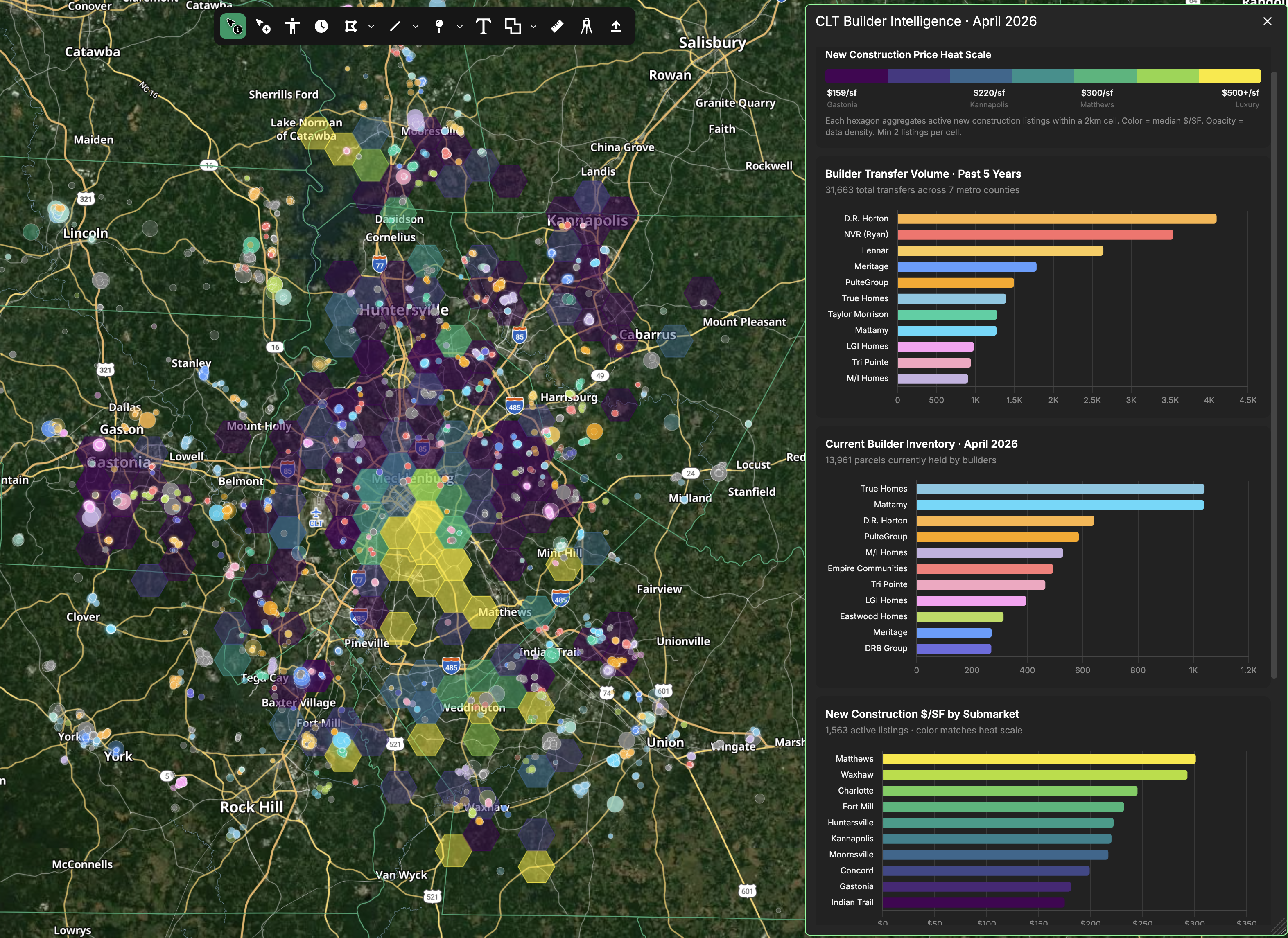
A parcel can check every technical box — zoning, utilities, and access — but still not work due to local politics.— Carter Malloy · Founder & CEO, Acres.com · Acres × Hamlet partnership announcement, February 23, 2026
Across the 40 Charlotte council meetings indexed for this analysis (April 2024 through April 2026), the I-77 South Express Lanes project surfaced in council speech fewer than two utterances per month on average. In February 2026 the count jumped to twenty- three, almost all of them from this single meeting. NCDOT and the city worked out a private compromise on March 2, the day of the council retreat — the agency agreed to delay issuing an RFP until June. WFAE’s March 13 piece judged the result: “the state holds the cards — and Charlotte leaders blinked.” The matter returned to the dais on April 27, 2026; Mayor Lyles placed the resulting seven-page resolution on the May 11 agenda. The April utterance count was thirteen.
Mayor Lyles, who had presided through three hours of testimony and deliberation, spoke briefly near midnight. She said: “We all know that McCrorey Heights is a special neighborhood. You know, I grew up with my aunt’s house still there. So when you start doing these kinds of projects, they do get to be where you have a place where it’s human to you.” It was the only personal note Lyles offered all evening. The motion that ultimately passed was a motion to add the project to the council’s March 2 retreat agenda. That is, formally, what the meeting decided.
What it also showed was that eight council members and a mayor held incompatible ideas about how city power works on a state project. The retreat motion bought a week to figure out which idea was right. The retreat happened, and WFAE’s March 13 read of it was unsparing: “the state holds the cards — and Charlotte leaders blinked.” A committee meeting on April 27 followed. A seven-page resolution — directing Charlotte’s CRTPO delegate to withhold support — is now scheduled for the dais on May 11, 2026. None of these steps stops the project. Each one buys the council another chance to decide which approach was right.
The full meeting transcript, searchable and timestamped against the YouTube video, is at myhamlet.com. Hamlet maintains the same indexing for 25,000 other US local governments.
The meeting: We pulled the official video for the Charlotte City Council Business Meeting of February 23, 2026 from the City's CLTgov YouTube channel and transcribed it via AssemblyAI's Best speech model with speaker diarization enabled. The result: 508 utterance segments across 2 hours 56 minutes of recorded deliberation, all timestamped to the second.
Speaker attribution: AssemblyAI labels speakers anonymously (Speaker A, B, C…). To map those labels to specific council members, we passed sampled utterances per speaker plus the canonical Charlotte council roster to Gemini 3.1 Pro for a one-shot attribution pass. Charlotte's elected dais is the mayor (Vi Lyles) plus eleven council members: four at-large (Ajmera, Watlington, Mayfield, Mitchell) and seven district (Anderson D1, Graham D2, Mayo D3, Johnson D4, Mazuera Arias D5, Owens D6, Driggs D7). We applied any mapping at confidence ≥ 0.70. For this meeting, mean applied confidence was 0.97. Of the eight council members who spoke on I-77, all eight were correctly attributed; Mayor Lyles's remarks were also attributed at high confidence. Joi Mayo, Victoria Watlington, and LaWana Mayfield (absent) did not speak on I-77 and are not in the speakers table.
Quote verification: Every quote in this article was checked twice against the source. The transcript text was confirmed verbatim against the canonical-v1 utterance row, and the timestamp range was opened in the YouTube video to confirm the speaker spoke those words at that moment.
What we did not do: We did not interview any council member. We did not contact NCDOT or CRTPO. We did not infer voting positions where members did not state them. We did not characterize Ed Driggs's argument as objection or support — he stated his position in his own memo, which we excerpted but did not editorialize.
Reproduce it: All counts in this article are reproducible from canonical-v1, the public-meeting warehouse that powers Hamlet (myhamlet.com). Every utterance referenced has a stable transcript_id + sequence pair. The 40-meeting Charlotte corpus that anchors this analysis is in canonical-v1 today; the production search index at myhamlet.com is being promoted on a rolling basis. Readers who want to query the underlying transcript IDs ahead of that promotion should contact us directly.
Partner data: The CLT Builder Intelligence map embedded above is supplied by Acres, the land-intelligence platform Hamlet announced a public data partnership with on February 23, 2026 — the same date as the council meeting this article reconstructs. Acres maintains parcel-level data on roughly 150 million U.S. land parcels and serves builders, data-center developers, commercial real-estate teams, and lenders. The map shown was generated by Acres from its production platform on the underlying builder transfer-volume, parcel, and submarket-pricing data; Hamlet did not pay for, modify, or filter the analysis. The accompanying announcement is at https://landvalues.acres.com/acres.com-hamlet-partner-bring-local-government-sentiment-data-land-intelligence.
Get data-driven local government stories in your inbox every week. Free, no spam.
Explore local government data on HamletAll claims in this article are grounded in public records, government data, and independent reporting.