The Newcomer’s Question
Charlotte’s council received 879 rezoning petitions across two years and approved almost every one that reached a vote. It also talked about housing more than any other subject — 928 attributed utterances. The newest member of the council was the first to articulate, from the dais, why those two facts coexist.
One member, one argument
On Monday evening, April 13, 2026, roughly six hours into a Charlotte City Council Business Meeting, Council Member JD Mazuera Arias of District 5 took the floor on a $3.5 million Housing Trust Fund request for 1001 Tyvola — a 297-unit existing apartment community a quarter-mile from the LYNX Blue Line, which the request would convert into preserved naturally-occurring affordable housing with 100 units under a 60-year affordability covenant and another 100 units under a 20-year covenant. Two-thirds of the building, in other words, would be locked in as affordable for at least two decades. Mazuera Arias had been on the dais for one hundred and thirty days. He had won the District 5 Democratic primary by 34 votes after a September 2025 recount, then faced no Republican opponent in November — a sequence that, in a one-party town, is how a council seat actually changes hands. He is the council’s first Latino member and its first Gen Z member, a former DACA recipient naturalized in 2021, and a 2020-21 Congressional Hispanic Caucus Institute Public Policy Fellow placed in the office of Rep. Alexandria Ocasio-Cortez. He has said publicly that he grew up in the Castlewood and Silver Oaks apartments, two East Charlotte complexes inside the same District 5 he now represents (Silver Oak was rezoned in 2011, its tenants displaced in late 2013, and the complex was demolished in 2014, replaced by the Meridian Place mixed-use development on Monroe Road; Castlewood remains).
What he said next is reproduced verbatim from the meeting transcript, sequence 555, at five hours and fifty-eight minutes into the recorded session: “We won’t build our way out of the affordable housing crisis by reconcentrating low income communities with low income housing. I am pro affordable housing equity, meaning that we have to couple affordable housing with high opportunity zones.”
Two propositions, in twenty-eight seconds. The first cut against the standard pro-supply argument that more housing of any affordable-eligible type is better than less, by naming a pattern — reconcentration — in which the city’s affordable approvals stack on top of areas that already have low-income housing. The second proposed an alternative: place affordable housing in “high opportunity zones,” the planning term for neighborhoods with strong schools, low crime, employment access, and intergenerational mobility.
The framework Mazuera Arias is reaching for has a long lineage. Raj Chetty’s Opportunity Atlas at Harvard published the original tract-level data on intergenerational mobility; the Fair Housing Act’s affirmatively- furthering-fair-housing duty (the underlying statute survived the March 2025 termination of the regulatory rule); and Charlotte’s own 2040 Comprehensive Plan, adopted June 21, 2021 by a 6-5 council vote — the council’s decisive split ran through Policy 2.1, the proposal to allow duplexes and triplexes in single-family zones; Council Member Watlington offered an amended motion that would have adopted the plan while delaying Policy 2.1 pending a feasibility study, and voted no when that amendment failed 6-5 — organizes city land-use decisions around an Equitable Growth Framework with four equity metrics: Access to Essential Amenities, Goods and Services; Access to Housing Opportunity; Access to Employment Opportunity; and Environmental Justice. No other Charlotte council member, in two years of indexed floor speech, has stated the high-opportunity-zones argument as cleanly. The rest have cited process, displacement, and density — not the geography of where affordable housing should land.
We won't build our way out of the affordable housing crisis by reconcentrating low income communities with low income housing... I am pro affordable housing equity, meaning that we have to couple affordable housing with high opportunity zones.— JD Mazuera Arias · Charlotte City Council, April 13, 2026, NC
928 speeches, one denial
Across 40 Charlotte council meetings between April 2024 and April 2026, council members spoke 12,370 utterances we could attribute by name with high confidence. Of those, 928 are about housing — rezoning petitions, the Unified Development Ordinance, affordable-housing programs, displacement, density, the 2040 Comprehensive Plan, the Equitable Growth Framework. That is more than the council said about any other single policy area: more than transit (915), more than police accountability (404), and many times more than the I-77 South Express Lanes (62). The two categories are not even close.
What got filed in the same period: 879 rezoning petitions with the City of Charlotte. What got resolved by a final vote: roughly 198. What got approved: roughly 196 — an approval rate the city’s open-data dashboard consistently shows north of 98 percent. The remaining 681 petitions are still pending. The council’s most-discussed problem generates one of the highest approval rates in city government — against a backdrop of a Mecklenburg-County-estimated 36,000-unit affordable housing deficit (the figure the Foundation For The Carolinas uses to anchor the “A Home For All” framework), a $100 million city housing bond Charlotte voters passed with 63.6 percent in November 2024, and a separate private-sector $102 million Housing Impact Fund — led by retired Charlotte investment bankers Erskine Bowles and Nelson Schwab, announced on April 27, 2026 — that aims to lock in twenty-year affordability covenants on at-risk apartment buildings.
Two members carry half the housing speech
The 928 housing utterances do not distribute evenly. Two speakers — District 1 Council Member Dante Anderson and Mayor Vi Lyles — account for more than half of them. Anderson alone delivers 271 housing utterances, 29.2 percent of the total. Her District 1 spans Uptown east through Plaza Midwood, NoDa, Dilworth, Myers Park, Elizabeth, and Grier Heights — a mix of legacy wealth, gentrifying corridors, and historically Black neighborhoods inside the I-277 ring. Anderson is also a former Mayor Pro Tem whose committee portfolio has long included housing work that does not appear on the dais; the floor-speech counts in this article do not credit committee-room work, the Housing Trust Fund advisory pipeline, or closed-session land deals. Lyles, the mayor, speaks because nearly every contested item routes through her chair.
The second column tells a different story: how often the word “affordable” specifically appears in those housing utterances. Anderson, with 271 housing utterances, mentions “affordable” in eight of them — three percent. Lyles, with 221, mentions it twenty-two times: ten percent. Driggs, the council’s sole Republican, mentions it three times in 68 housing utterances: four percent. Watlington speaks on housing 31 times in two years and uses the word “affordable” twice. The keyword is one signal among several — members may speak to affordability using “attainable,” “workforce,” “naturally occurring,” or “subsidized” — but it is the signal Charlotte’s public-record language about affordable housing keeps returning to.
The two members with the highest affordable-rate are Mazuera Arias (six of fourteen, 43 percent) and Malcolm Graham (ten of thirty-one, 32 percent). Both speak about housing seldom — 14 and 31 utterances respectively — and both use the term proportionally more often than any colleague. The two other Dec 2025 newcomers, Owens and Mayo, have spoken on housing 9 and 3 times respectively, and have not used the word “affordable” on the record we have. The table below sorts in descending order of housing volume.
| Member | Role | Housing utts | “Affordable” utts | Affordable rate |
|---|---|---|---|---|
| Dante Anderson | Council Member, District 1 | 271 | 8 | 3% |
| Vi Lyles | Mayor | 221 | 22 | 10% |
| LaWana Mayfield | Council Member, At-Large | 107 | 16 | 15% |
| Dimple Ajmera | Council Member, At-Large | 90 | 21 | 23% |
| Ed Driggs | Council Member, District 7 | 68 | 3 | 4% |
| Reneé Perkins Johnson | Council Member, District 4 | 66 | 21 | 32% |
| Victoria Watlington | Council Member, At-Large | 31 | 2 | 6% |
| Malcolm Graham | Council Member, District 2 | 31 | 10 | 32% |
| James Mitchell | Mayor Pro Tem | 17 | 6 | 35% |
| JD Mazuera Arias | Council Member, District 5 (sworn in Dec 2025) | 14 | 6 | 43% |
| Kimberly Owens | Council Member, District 6 (sworn in Dec 2025) | 9 | 0 | 0% |
| Joi Mayo | Council Member, District 3 (sworn in Dec 2025) | 3 | 0 | 0% |
The largest filer the council never names
Who files rezoning petitions reveals what kind of housing Charlotte actually approves. The top ten petitioners account for roughly 130 of the 879 filings in the window. The City of Charlotte itself files the most — nineteen, almost all of them parks, parking facilities, and street annexations. After the city, the largest private filer is Northwood Ravin (15 petitions), the Charlotte-headquartered multifamily developer co-founded in 2011 by David Ravin and John Z. Kukral as the Southeast operating arm of Northwood Investors. Then DreamKey Partners (13), the non-profit affordable-housing developer formerly known as Charlotte-Mecklenburg Housing Partnership, which rebranded in 2021.
| Petitioner | Sector | Petitions filed |
|---|---|---|
| City of Charlotte (parks, parking, annexations) | city | 19 |
| Northwood Ravin | private | 15 |
| DreamKey Partners | nonprofit-affordable | 13 |
| Wilkes Asset Management | private | 12 |
| Charlotte Planning, Design & Development (text amendments) | city | 11 |
| Drakeford Communities | private | 11 |
| Angelo Tillman | individual | 11 |
| The Drox Group | private | 10 |
| Charlotte-Mecklenburg Hospital Authority | institution | 9 |
| The Drakeford Company | private | 9 |
Look at the second column: how often each major petitioner is mentioned by name in the 12,370 attributed council utterances. Drakeford and DreamKey are mentioned equally often, twenty-one times each. (The Drakeford Company’s principal, Bobby Drakeford, was appointed to the North Carolina House in September 2024, which the article notes for transparency; the Drakeford count in our table predates and postdates that appointment.) Wilkes is mentioned ten times. Hines, the national developer that filed a major SouthPark mixed-use rezoning in October 2025 under an LLC name our petitioner-name match did not catch, eight times. Northwood Ravin — the largest private filer our match did catch — is mentioned by name zero times in 12,370 attributed utterances. Council members frequently reference rezoning matters by petition number or site address rather than by petitioner name, which explains part of the gap. It does not explain why DreamKey, the non-profit, gets named at the same rate as Drakeford while Northwood Ravin, with more petitions filed than either, never does.
| Petitioner | Council utts mentioning by name | Petitions filed in window |
|---|---|---|
| Drakeford (combined) | 21 | 20 |
| DreamKey Partners | 21 | 13 |
| Wilkes Asset Management | 10 | 12 |
| Hines | 8 | — |
| Northwood Ravin | 0 | 15 |
Reconcentration
The reconcentration argument Mazuera Arias raised on April 13 has a specific Charlotte history. The $50 million November 2018 affordable-housing bond, the June 21, 2021 adoption of the 2040 Comprehensive Plan (a 6-5 council vote, with Council Member Watlington among those who tried to delay the duplex / triplex policy until further feasibility study), the March 28, 2022 Charlotte Future 2040 Policy Map, and the August 22, 2022 Unified Development Ordinance (effective June 1, 2023) all formally embraced equitable distribution as policy. The west-side and east-side corridors that residents consistently describe as already-saturated with subsidized housing — Beatties Ford Road, West Boulevard, parts of Eastland — are the same corridors most often named in council’s own displacement debates. Mazuera Arias did not name a developer. He named the pattern.
Whether the petition stream actually reflects the 2040 Plan’s equity goals is an empirical question that requires geocoding the 196 approved rezonings against Charlotte’s own equity-metrics map. We did not do that geocoding for this article. What we can say is what the speech record shows: in the 928 attributed council utterances on housing, the words “opportunity zone,” “Place Type,” and “equitable growth” appear sparingly. The council’s housing speech is mostly about individual projects and individual neighborhoods, not the framework that is supposed to govern where projects go.
A parcel can check every technical box — zoning, utilities, and access — but still not work due to local politics.— Carter Malloy · Founder & CEO, Acres.com · Acres × Hamlet partnership announcement, February 23, 2026
That is the gap Mazuera Arias was naming. He was not opposing affordable housing. In his framing, he was opposing affordable housing in places he argued already carry a disproportionate share of the city’s affordable inventory. The personal stake is on the public record: Mazuera Arias grew up in the Castlewood and Silver Oaks apartments in East Charlotte, in the same District 5 he now represents. He proposed a different test: couple every approved affordable project with the equity-metrics data that Charlotte’s own plan adopted in 2021, and ask whether the project moves the equity needle or reinforces the existing concentration. As of May 2026, that test has not been formally adopted as a council decision rule. The 1001 Tyvola request passed at the same April 13, 2026 Business Meeting where Mazuera Arias spoke — Item 14, Legistar File 15-25915, "Naturally Occurring Affordable Housing Preservation Support for 1001 Tyvola Apartments." The Legistar agenda summary records the matter as Pass; the detailed roll call had not yet been published when this article went to press.
What we’re watching
Charlotte’s council is mid-cycle on a UDO refinement process the city has been running since adoption of the ordinance in 2022. The council has scheduled UDO-related items on multiple 2026 agendas; the next major hearing is expected in summer 2026. Mazuera Arias has been on the dais for one hundred and thirty days at the time of his April 13 statement. We will be watching whether his opportunity-zones argument shapes the next round of UDO text amendments, or whether it remains an outlier in the indexed floor speech of the body he sits on.
We will also be watching the per-member affordability rate. If the rate among the council’s three Dec-2025 newcomers (Mazuera Arias, Owens, Mayo) climbs as they establish their voices, that will tell us something about whether the council’s housing argument is generationally shifting. If it does not, that will tell us something different.
The full April 13, 2026 transcript, searchable and timestamped against the source video, is at myhamlet.com. The full per-member counts behind every figure in this article are reproducible from the same warehouse.
How we made this
The corpus: Forty Charlotte City Council meetings between April 2024 and April 2026, transcribed via AssemblyAI's Best speech model with speaker diarization. Council Business Meetings and Council Zoning Meetings, both. Total recorded audio: roughly 148 hours. Total utterance segments: 107,202.
Speaker attribution: AssemblyAI labels speakers anonymously. We mapped those labels to the eleven council members plus the mayor using Gemini 3.1 Pro one-shot mapping against Charlotte's elected roster (four at-large members — Ajmera, Watlington, Mayfield, Mitchell — and seven district members: Anderson D1, Graham D2, Mayo D3, Johnson D4, Mazuera Arias D5, Owens D6, Driggs D7). 12,370 of the 107,202 utterances are attributed to specific council members at confidence ≥ 0.70. Mean applied confidence: 0.96. The remaining 95,000 utterances are staff, public commenters, or speakers below the confidence floor.
Topic classification: Every utterance was classified by topic using a regex-and-keyword pass against the canonical-v1 transcript text — housing, zoning, UDO, rezoning, affordable housing, Charlotte Future 2040, Place Types, Equitable Growth, opportunity zones, and a small number of synonyms. We counted an utterance as 'housing' if any of those terms appeared. We counted an utterance as 'affordable' if it specifically mentioned 'affordable' (not 'attainable,' which is a separate keyword and a separate framing).
Rezoning petition data: All 879 rezoning petitions filed with the City of Charlotte between April 2024 and April 2026, pulled from the City's Legistar API and the Charlotte Open Data Portal. We classified each by petitioner sector (private, city, nonprofit-affordable, institution, individual) using a manual pass against the petitioner roster. The single denied petition (2025-042) was filed by an individual, not a corporate developer.
Quote provenance: The anchor quote from Council Member Mazuera Arias is sourced to canonical-v1 transcript b209a663-94e7-4b8c-bd7a-f87b21946fb2, sequence 555, start time 21,519 seconds (5:58:39 in the source video, YouTube ID W5DGZVl1Htc — the City of Charlotte's official upload of the April 13, 2026 Council Business Meeting). The transcript was generated by AssemblyAI's Best speech model with diarization (mean attribution confidence for this meeting: 0.96). Auto-transcription occasionally introduces minor wording drift; readers who want to verify the exact phrasing can open the timestamp directly. The structurally identical position — coupling new affordable housing with infrastructure and amenities, not concentrating it in already-saturated corridors — appears in Mazuera Arias's own public statements on WBTV (April 8, 2026) and on his campaign site.
What we did not do: We did not interview any council member. We did not contact named developers or DreamKey Partners. We did not infer voting positions where members did not state them. We did not characterize Mazuera Arias's argument beyond what he said on the record on April 13, 2026. The 'reconcentration' framing in section eight is his word, not ours.
Reproduce it: All counts in this article are reproducible from canonical-v1, the public-meeting warehouse that powers Hamlet (myhamlet.com). Every utterance referenced has a stable transcript_id + sequence pair, and every rezoning petition has a Legistar matter ID linked from the City of Charlotte's records. The 40-meeting Charlotte corpus is in canonical-v1 today; the production search index at myhamlet.com is being promoted on a rolling basis. Readers who want to query the underlying transcript IDs ahead of that promotion should contact us directly.
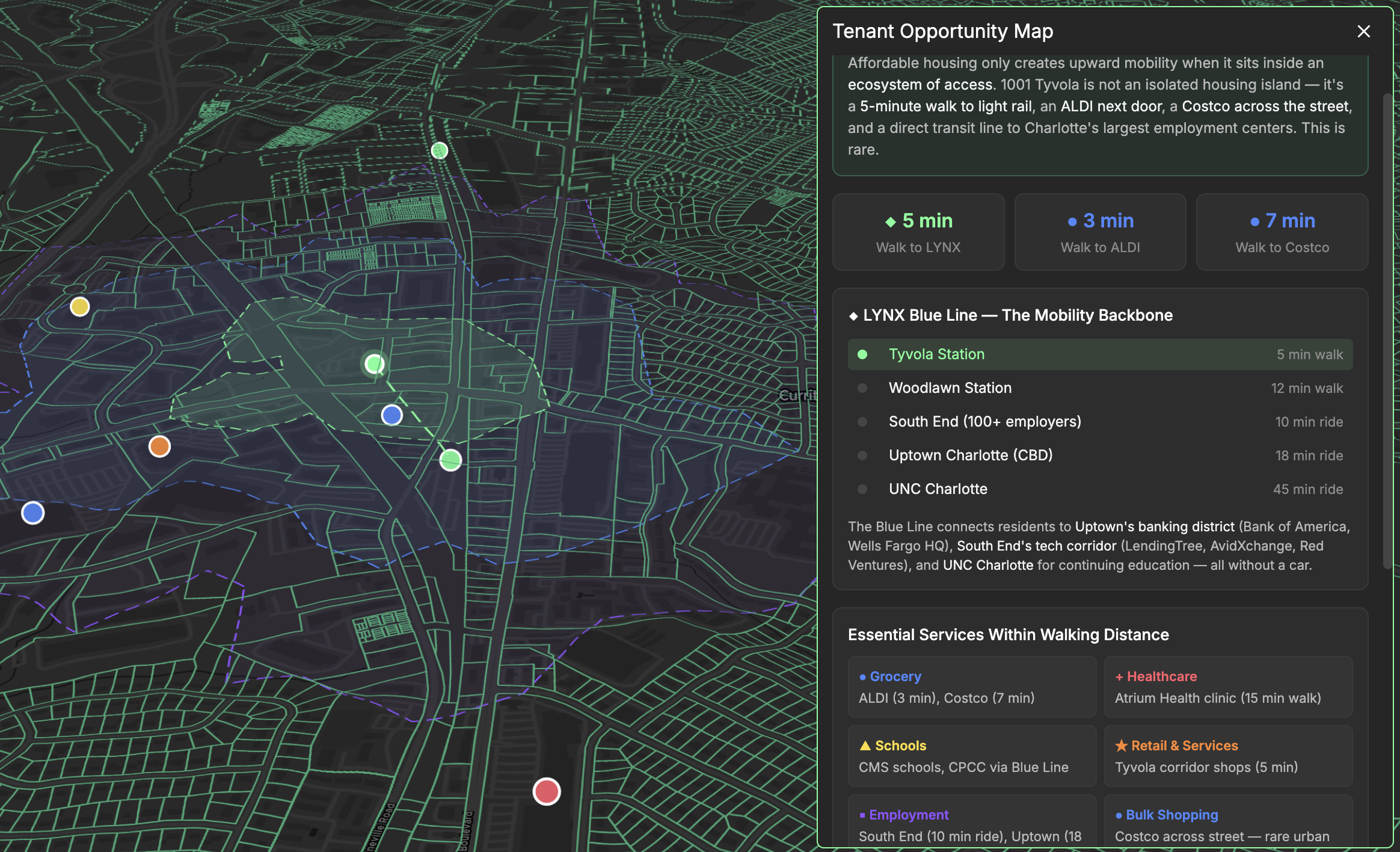
Partner data: The Tenant Opportunity Map for 1001 Tyvola embedded above is supplied by Acres, the land-intelligence platform Hamlet announced a public data partnership with on February 23, 2026. Acres maintains parcel-level data on roughly 150 million U.S. land parcels and serves builders, data-center developers, commercial real-estate teams, and lenders. The map shown was generated by Acres from its production platform on the underlying walkability and transit-access data for the 1001 Tyvola parcel; Hamlet did not pay for, modify, or filter the analysis. Acres CEO Carter Malloy curated the view in response to a draft of this article. The accompanying announcement is at https://landvalues.acres.com/acres.com-hamlet-partner-bring-local-government-sentiment-data-land-intelligence.
Enjoying The District?
Get data-driven local government stories in your inbox every week. Free, no spam.
Explore local government data on HamletSources & Data
All claims in this article are grounded in public records, government data, and independent reporting.
- Charlotte City Council Business Meeting — April 13, 2026 (full video)City of Charlotte (CLTgov YouTube)
- Charlotte City Council Meeting RecordsCity of Charlotte Legistar
- Charlotte Open Data Portal — Rezonings datasetCity of Charlotte
- Unified Development Ordinance (UDO)City of Charlotte Planning, Design & Development
- Charlotte Future 2040 Comprehensive Plan — Equity & Opportunity MapCity of Charlotte
- JD Mazuera Arias edges out District 5 incumbent Marjorie Molina (recount)WFAE 90.7 (September 9, 2025)
- East Charlotte shoppers lose major grocery store; council member warns of growing 'amenities gap'WBTV (April 8, 2026)
- Charlotte City Council Business Meeting — April 13, 2026 (Legistar agenda)City of Charlotte Legistar
- Charlotte City Council considers $3.5M Housing Trust Fund request for 1001 TyvolaWCNC
- Charlotte 2040 Comprehensive Plan adopted in 6-5 council voteWBTV (June 21, 2021)
- Charlotte 2024 Housing Bond Measure (passed 63.6%)Ballotpedia
- Housing Impact Fund raises $102 million for affordable-housing preservation in CharlottePRWeb (April 27, 2026)
- Charlotte City Council seats three new members; Mitchell elected mayor pro temWFAE 90.7 (December 2, 2025)
- DreamKey Partners — affordable-housing developerDreamKey Partners
- Charlotte Future 2040 — Place Types and Equitable Growth FrameworkCity of Charlotte
- Charlotte council records on HamletHamlet — myhamlet.com
- Acres — land-intelligence platformAcres
- Acres + Hamlet partner to bring local-government sentiment data to land intelligenceAcres / Hamlet (joint announcement, February 23, 2026)